What Goes into a Great Audio Performance? So Much More Than Reading Aloud.

As a child, Luke Daniels couldn’t wait for his turn to read aloud in front of the class. “I’d count the number of kids going before me so I could find which line would be mine and mentally rehearse it,” he says. That kid would go on to narrate more than 1,000 audiobooks and win numerous awards, including recognition as an inductee into Audible’s Narrator Hall of Fame. Daniels says he still gets messages from former classmates saying they remember what a great reader he was. But where the craft of narration is concerned, an innate love of reading aloud is just the tip of the iceberg.
The job begins with a good amount of pre-production work: reading through contracts, coordinating schedules around the call sheet that says where to be and when, and arranging travel if they’re not recording at home. But no matter what, one of the first things all narrators must do is immerse themselves in the material, and often without much lead time. “They might only have a few days to look at the book before they record,” says Audible producer Sara Pagluica.
In that time, narrators are expected to read the book cover to cover, immersing themselves in the story and characters, noting the overall mood as well as the emotional levels of each scene, and making decisions about how to voice each character. This initial prep work is one of the main disciplines Pagluica covers in the workshops she teaches with longtime, award-winning narrator and producer Khristine Hvam. Hvam says when she narrated the Chronicles of Elantra series, which features over 100 characters across multiple races, “I chose different accents for each race to help the listener distinguish between them. Then I added layers of personality, age, gender, and attitude to each one.” She likes to recommend an online tutorial series to help narrators rehearse and learn new accents.
“Prepping also includes making sure they’re researching pronunciations if they need to, or asking for help,” adds Pagluica. Ideally, they will have reached out to the publisher, or in some cases, like when working with independent creators through Audible’s Audiobook Creation Exchange (ACX), the author themselves. That responsibility becomes especially visible in science fiction and fantasy, where authors invent entire lexicons. Increasingly, publishers are supplying pronunciation keys along with the manuscript. Pagluica recommends getting that key in audio, not just phonetic spellings, “because then you can hear exactly how the author wants it,” she explains.
All this prep work gets annotated in the script for easy reference and visual cues during recording. Each narrator has their own system of symbols to mark different characters, emotional states, where to take a breath, and so on. While most use tablets for a more soundless experience in the booth, some still use paper scripts.
As for the physical toll of recording, it varies by production schedule and book length. Generally, a nine-hour audiobook takes three days in the studio. That includes doing additional takes, and many narrators prefer to stay well under six hours of recording in one day. Hvam adds, “Certain accents, especially those with a hard ‘R’ sound, like Irish and Southern, are done with tighter jaws. After a couple of hours, I might be like (massaging her cheek), ‘Ow!’”
There are tricks of the trade to help performers maintain vocal integrity and stamina, while also ensuring clean audio. Daniels tends to record in the morning on an empty stomach. “Don't drink a big latte with a bunch of bread and carbs,” he warns. “Your stomach's going to make sounds that are picked up by the mic.” He’ll even sip water but not swallow it, since that can create burps and other noises. Pagluica says they can edit out most sounds, but it slows production, and noises underneath a spoken line require another take.
As multicast performances grow in popularity with listeners, narrators are finding more opportunities to creatively collaborate with each other. Daniels has experienced everything from several people recording in the same room to fully remote casts, but no matter the scenario, the cast needs to get on the same page about character choices so the performances feel coherent instead of a collage of solo reads. “If there’s another narrator, I may not go as broad,” Daniels explains. “We meet in the middle, because if I’m doing big stuff, and the other person's reading it very sincere and straightforward, the tone's not going to match.”
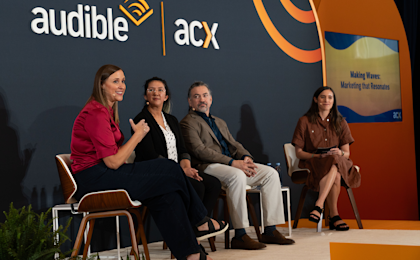
Fortunately, most of the time, they’re performing with people they’ve worked with before, sometimes for years. “They are all so nice,” says Audible editor Katie O’Connor. “It's such a warm and welcoming community. Everyone is truly invested in each other's success, and they're trying to lift each other up.” This extraordinary support and camaraderie was evident at our April event celebrating the re-launch of Audible’s Narrator Hall of Fame, where narrators thanked each other for mentoring them in the field.
Audible’s listenership has grown worldwide in part because narration has evolved from “straight reads,” as Daniels puts it, meaning simply reading the words on the page, into the art form found throughout Audible’s catalog today, filled with character choices, accents and emotions that immerse listeners more deeply.
That’s why “people are obsessive about their narrators,” says O’Connor. “Customers want to shop by narrator. Our ‘best of’ lists are always going to look different from the others, because the performance matters so much. It has to be different and special in audio,” and narrators have ways to “elevate the performance and make it its own piece of art.”
O’Connor points to “mega successful” narrators like Ray Porter as proof of how definitively a great performance can stamp itself on a story. In fact, Project Hail Mary star Ryan Gosling admitted he was grateful he hadn’t listened to Porter’s narration before filming, because he would have just been trying to imitate it in his own performance.
Audible’s editors connect narrators and fans through features like in-depth interviews, Mic Check, and Five Listens With. “People are hungry to know what our narrators love and what’s shaped them. They’re celebrities to our listeners.” Over the years, some of Daniels’ considerable fanbase have even turned into “straight up friends.” He adds, “One, a new author on ACX, brought his children up listening to the Iron Druid Chronicles, which I narrated. He’d written his own series and wanted to hire me. He was a fan who now employs me!”
In fact, ACX projects make up about half of Daniels’ annual work, and he loves working directly with independent authors to produce and then promote their audiobooks. Since ACX supplies free promo codes, Daniels uses giveaways to bring in new listeners and reward long-time followers, continuing to build his fanbase and attract fresh collaborators and opportunities.
Among narrators’ biggest fans? Audible producers, of course. When Pagluica is casting an Audible Original, she says, it’s often a combination of instinct and deep knowledge of the performers out there. “I might start reading a script or a book and pretty quickly be like, ‘Oh, I can only hear this person's voice.” Nicola Wall, a director of production and casting for Audible in the UK, says the team likes to bring a diverse range of emerging and well-known voices to multicast productions like Starlings and Harry Potter: The Full-Cast Audio Editions. She adds, “Sometimes there’s an exciting opportunity to pair a debut author with a well-known voice, as long as it’s right for the project. It can help bring a wider audience to the work.”
Even after a decade of working with narrators, Wall is still amazed by their craft and skill. “When someone is reading and it sounds natural, like they’re just telling you a story, and they effortlessly flip between all these voices for different characters, yet none of them feel like caricatures or impersonations — that’s magical.”
Hvam says when people ask her how she can spend so much time in the booth, she answers, “Because I’m not in there; I’m in the story.” For Daniels, it’s just another day at the office. “I used to be a diva when I was younger, and my dad, who is also a performer, would say, ‘There's no perfect circumstance. Just get in the booth, close the door, and start.’”